


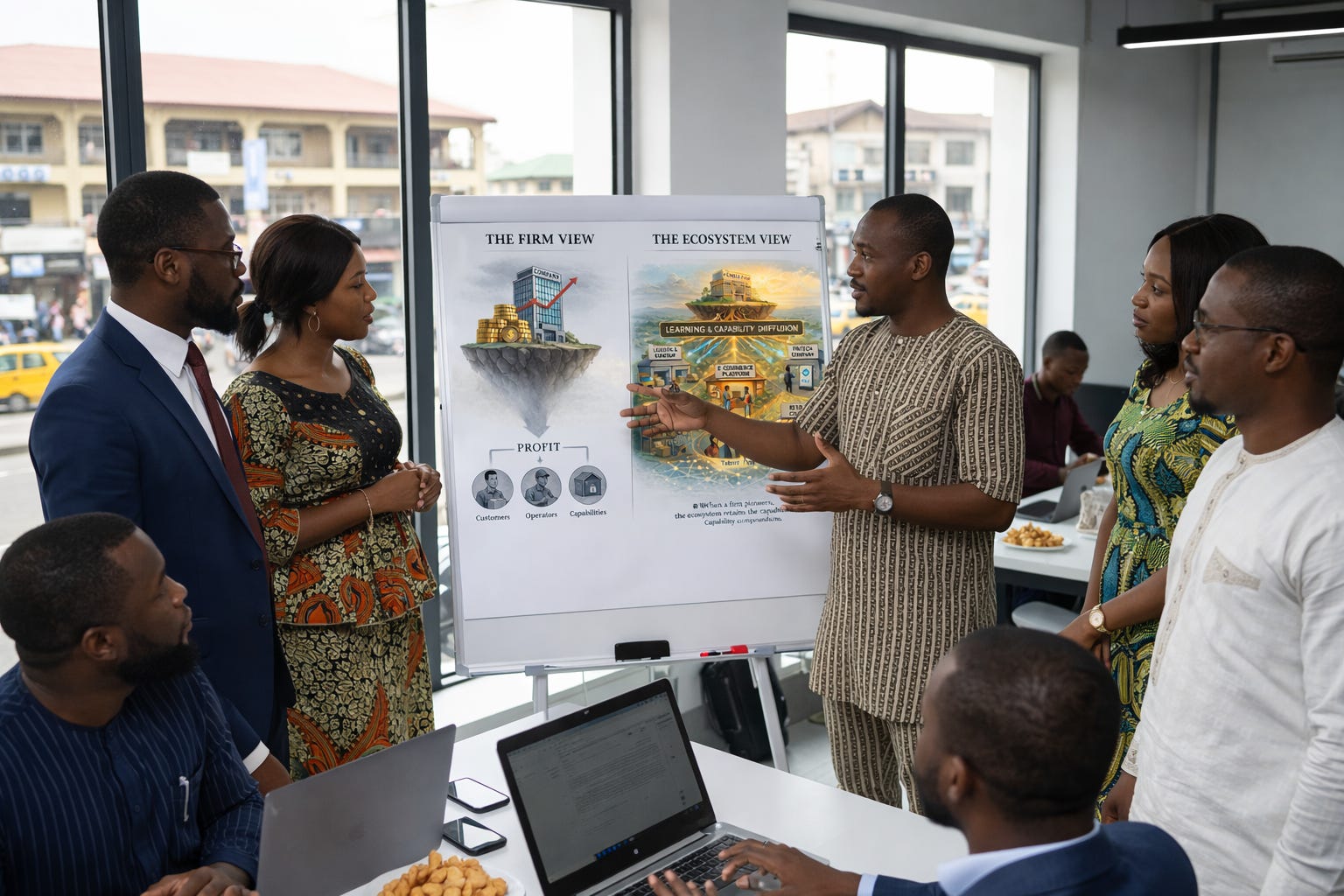
1. Silicon Valley: An Ecosystem View
Most startup analyses begin and end at the firm.
Did they raise capital?
Did they survive?
Did they become profitable?
How much was the return to investors?
What about founder outcomes?
These are the primary lenses. And they are very important. But when we move a step further they are incomplete.
When we talk about Silicon Valley, we point to trillion-dollar companies. But few people have heard of how the Valley was actually built. An older man born in 1957 in that area told me the story a fews ago. And I have was fascinated.
In 1957, eight engineers left Shockley Semiconductor Laboratory and formed Fairchild Semiconductor. Fairchild did not just manufacture chips. It concentrated talent. Inside that firm, people learned how to scale semiconductor production, raise venture capital, and run high-technology organizations. Then they left and did it again.
From Fairchild came Intel and Advanced Micro Devices.
But more importantly, from Fairchild came the capital foundation of the Valley. Eugene Kleiner, one of the original Fairchild founders, started Kleiner Perkins. Don Valentine, Fairchild’s head of sales, started Sequoia Capital.
Before them, technology startups relied on East Coast bankers. Bankers understood balance sheets. They did not understand silicon risk. Kleiner and Valentine were the first VCs local to the valley. They were operators funding operators.
Kleiner Perkins seeded Sun Microsystems, Netscape, Genentech, Amazon, and Google.
Sequoia backed Apple, Cisco Systems, Oracle, Yahoo, Paypal, Airbnb, Stripe and WhatsApp.
They took the operational density of a single company and turned it into the circulatory system of a geography.
Fairchild eventually declined, but Silicon Valley thrived. The ecosystem is a different unit of progress.
Forty years later, PayPal received early backing from Sequoia and carried that operator-led capital model into the internet era. It survived fraud wars and operational chaos before being acquired by eBay in 2002. But the acquisition was not the story. Its alumni went on to found Tesla, LinkedIn, YouTube, Palantir Technologies, Yelp, SpaceX, Affirm, Yammer and others. PayPal is valued today at $60-70 billion. The companies founded by the early alumni are valued at roughly north of $1.5 trillion dollars.
The ecosystem view is that the firm matters. But in the long term, its impact on the ecosystem matters even more.
2. E-commerce in Nigeria: An Ecosystem View
When we evaluate Jumia or Konga, we default to the same firm-level questions.
But in the early 2010s, large-scale e-commerce was not operationally real in Nigeria.
Customers were skeptical of remote payments. Last-mile delivery systems did not exist. Digital demand generation at scale was new. Marketplace coordination across multiple cities was largely untested. Early platforms had to solve problems that did not previously have local playbooks.
They had to train customers through repeated transactions. They had to experiment with logistics models under poor infrastructure. They had to design trust mechanisms like payment on delivery. They had to build internal operator density from scratch.
That learning did not disappear.
Employees left and joined logistics firms, fintech companies, retail chains and new startups. Customers who placed their first successful online order did not revert to pre-digital behavior. Operational templates were discovered. Failure patterns were mapped. Trust baselines shifted. The environment changed.
So much has been written on the Jumia Mafia, but here I will focus on customer education and the building of trust.
3. Schwartz’s Pyramid of Awareness & The Education Tax
Markets do not begin fully formed. They have to be constructed in the mind before they function in reality.
Eugene Schwartz described this progression through what is often called the Pyramid of Awareness. Customers move through stages:
Unaware.
Problem-aware.
Solution-aware.
Product-aware.
Most aware.
In mature markets, most consumers are already solution-aware. They know e-commerce works. They are simply choosing between platforms.
In early markets, the constraint is different.
When large-scale e-commerce launched in Nigeria, the dominant constraint was was awareness and trust.
Customers had to move from:
“This sounds risky.”
to
“This might work.”
to
“This works for me.”
That transition is expensive. It requires marketing intensity, operational reliability, repeated successful transactions, and public absorption of failure.
Millions of Nigerians placed their first online order through early platforms. That first successful delivery permanently expands behavioral possibility.
E-commerce moves from abstract theory to lived experience. Future companies inherit that shift. They do not need to prove that online ordering works. They only need to prove that they execute it better.
4. Payment on Delivery: Engineering Trust in a Low-Trust Market
In low-trust environments, innovation is behavioral before it is technological. Payment on delivery was not a convenience feature.
It acknowledged reality. Customers feared fraud. Digital payments were uncharted territory.
Consumer protection systems were weak. And there was always a risk of bad actors.
Rather than demand full upfront trust, early platforms absorbed operational complexity.
Deliver first. Collect later.
This simple design choice did three things at once.
It reduced perceived risk for first-time users. It accelerated category education. It created repeated successful experiences that gradually normalized remote commerce.
Trust was engineered through the process. And once customers experienced reliable delivery enough times, the baseline shifted. Subsequent companies entered a market that was already more trusting than the one that existed before.
5. An Ecosystem View: Capability Compounds
Capability compounds.
Jumia built scale on Payment on Delivery. That decision unlocked trust. It moved customers. It expanded the market. But scale built around a solution creates dependence on that solution.
Customer expectations harden. Operational systems optimize. Fraud controls, routing logic, working capital cycles, all adjust to that architecture. This is path dependence. The bridge that delivered trust is no longer temporary. If Jumia removes PoD, revenue will likely fall.
Meanwhile, new entrants enter a partially educated market without carrying that legacy structure. They push upfront payments and they inherit trust without inheriting constraint.
Today, even a random foreign seller can enter the Nigerian market, demand upfront payment, and operate at scale, because the customer has already been educated.
Thousands of SMEs sell through WhatsApp and Instagram. Delivery across cities is normal. Remote payments are routine. None of this was structurally normal fifteen years ago.
Someone moved first. The pioneers absorbed the skepticism and they absorbed the cost of education. Now the firm’s financial return is one metric. The market that becomes possible afterward is another.